Know what you’re building before you pay to build it.
Starts at $9,500. The required first step for every new software product we build. A two-day workshop, working sessions to define and design the first release, and a go-forward plan with the investment on it. You leave with click-through mockups, requirements, a technology recommendation, and a roadmap, and you own every artifact whether or not you build with us.
We won’t start a new build without one. Here’s why you shouldn’t either.
The industry builds the wrong thing well
Roughly 70% of software and data projects fail or run over — not because engineers can’t code, but because nobody validated the problem, the users, or the scope first. A VDP is how our success rate stays near 96.5% across hundreds of projects.
You see the blueprint before the foundation is poured
You wouldn’t let a builder start framing before you’d approved the drawings and the budget. A VDP is the drawings: scope, cost, timeline, and a prototype you can click — before a dollar of engineering is committed.
It buys alignment you can’t get any other way
Stakeholders, users, and (if you need them) investors or a board see the same problem statement, the same journeys, the same plan. Misalignment surfaces in a workshop instead of in month four.
Four parts. One plan you can act on.
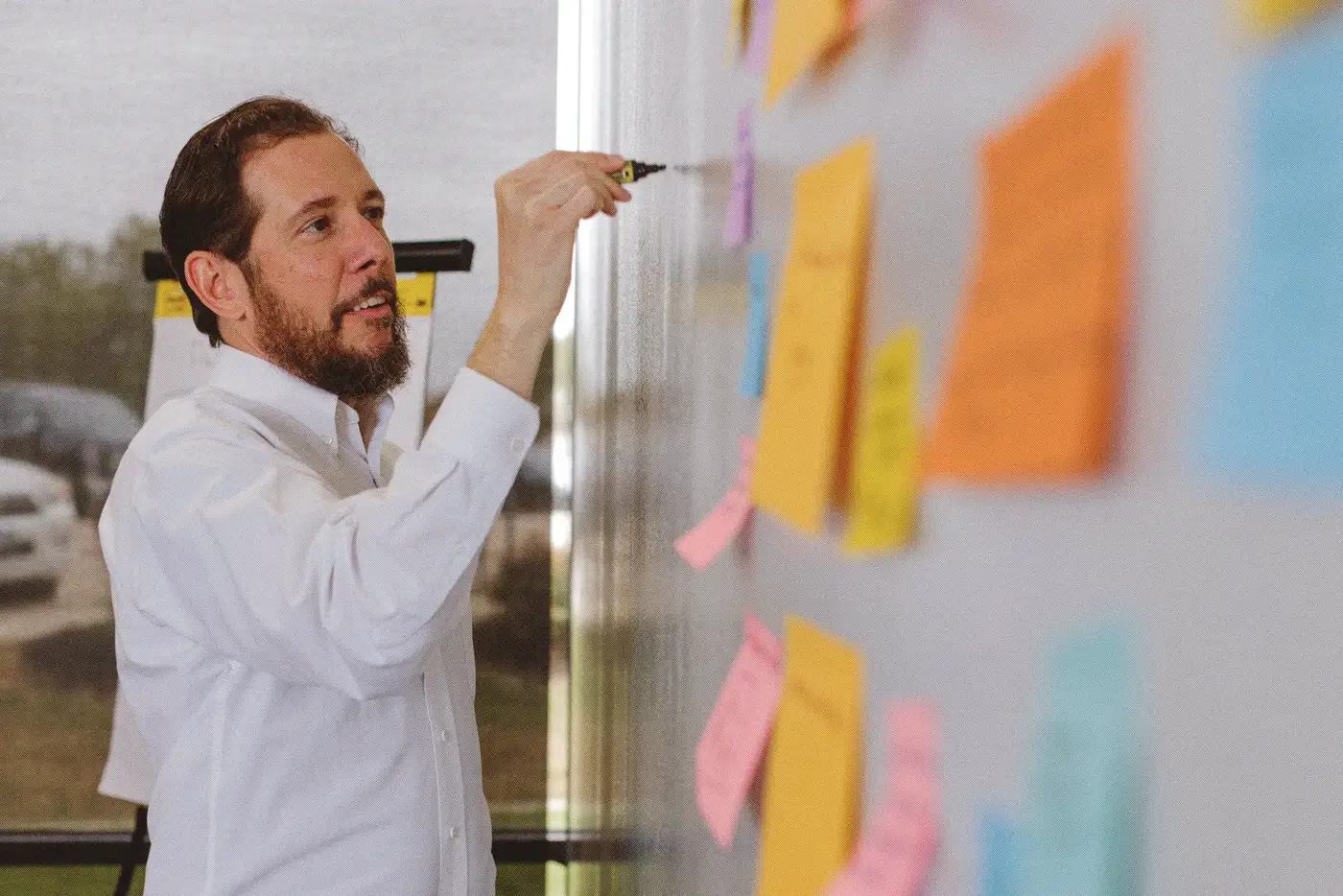
What you leave with
- Workshop outputs: stakeholder input, key decisions, and preliminary insights
- Vision and scope summary: near- and long-term vision, first-release scope, what comes later
- User roles and needs
- Click-through mockups of the key screens and workflows for the first release
- Functional requirements for the first release
- Non-functional requirements: security, performance, scalability, usability
- Technology-stack recommendation and key technical considerations
- Roadmap and future investment: milestones, a defined estimate for the first release, directional ranges for later phases
- Every artifact, yours, whether or not you build with us
What it costs
Covers the workshop, the research, the design work, and the plan. The build that follows is a separate proposal — with its own number — that comes out of the VDP. No obligation to take it.
Start a VDP conversationBecause your application begins and ends with the users.
Design starts long before anyone writes code. Coding is about languages and frameworks; design is the larger job of understanding the work, sketching the workflows, arguing about the risks, and putting something in front of real people to react to. We do it in English first, yours, not ours.
The workshop feeds the workflows. The workflows feed click-through mockups of the key screens your users can react to, so design issues get found while they cost a conversation, not a sprint. When engineering starts, it starts from a plan, not a hunch.
And we keep the design work proportional. A first release needs the key screens designed well, not every screen designed twice. The appetite for a big up-front design phase is gone, and so is ours.
Right for a new build. Wrong for a few other things.
A VDP fits if
- You’re building something that doesn’t exist yet — a product, a platform, a portal, an internal system
- You have a sponsor who can make decisions and the people who know the work available for a workshop
- You want a real number before you commit real money
- You need alignment across a leadership team, a board, or investors
- You want to own the plan — even if someone else builds it
Start somewhere else if
- The software already exists and the question is what to do with it — that’s a System Evaluation
- You want one workflow automated on systems you already run — that’s AI Office
- You want a fixed build price today, before anyone understands the problem
- Nobody with decision authority can be in the room
Existing system? System Evaluation. One workflow to automate on systems you already run? AI Office. Not sure your organization is ready to build anything yet? Take the 5-minute readiness assessment first.
Validated first, then built.
Car Wars: 1,300+ Downloads in Month One — a Mobile App Validated, Planned, and Shipped for a Trade-Show Deadline
Car Wars, a Call Box company whose cloud phone system serves automotive sales teams, needed a mobile app — texting, softphone, performance dashboard, push — in seven months, with no in-house mobile team. A Validation, Design & Planning (VDP) engagement first, then the build: 1,300+ downloads in the first month, a 99.7% bug-free rate, and a 5-star App Store rating.
Built From Zero to $14M+ in Funded Growth and Adoption by the World's Top Law Firms
A legal collaboration platform built from the ground up — adopted by Cooley, CMS, and Fortune 500 corporate legal teams, and backed by $14M+ in funding after launch.
A Non-Partisan Civic Polling Platform, Idea to Market in 6 Months
A non-partisan civic platform that gives elected officials a direct, statistically meaningful read on constituent sentiment — built and launched on web and mobile in six months, under budget and on time.
What the room feels like.
The initial discovery event was facilitated so well, and I felt that when the two days were done, you all understood our problem to solve and needs very well. I was impressed.
Everyone’s ability to really understand what we’re trying to do is just impressive and exciting. Y’all have picked up on everything quickly without a lot of explanation. This has given us a lot of confidence to move forward.
Five steps, every time.
For a new build, “Engage” means the VDP first — then the proposal for the build comes out of it.
- 01Discovery Call30–60 min
You tell us the problem in your words. We tell you straight whether — and where — we can help. No slides.
- 02Deep Dive60–90 min
The people closest to the problem, in one room (or one call). We get to the real constraint and the number that matters.
- 03Proposal & Paperworkdays, not weeks
Scope, price, and timeline in writing. A standard MSA and a short SOW — no 50-page lock-up.
- 04Prep & Kickoffweek 1
Access, environments, and a kickoff with everyone who touches the work. You know who’s on it and what ships first.
- 05Engageongoing
The work itself — visible every week, in your environment, with your people in the loop.
Straight answers.
Do we have to build with you afterward?
No. Every artifact is yours, and there are no rules about what you do with them. Most clients do move into the build with us, but the VDP is priced to be worth it on its own. Some clients leave with clarity that the product isn’t right for the business yet — and a plan for when it is.
How long does a VDP take?
Three to four weeks for a focused first release, starting with a two-day workshop and then roughly two working sessions a week. Bigger scopes take longer. The exact duration depends on how quickly your team can meet, answer questions, and make decisions, and we set it with you before we start.
Who needs to be involved from our side?
A sponsor who can decide, a product owner who can decide fast, the subject-matter experts who know the work, whoever owns your existing technology, and some real users. Nominate one point of contact per group if a group is large. The three things that matter most in the workshop: in person, the right mix of people, and everyone there for the whole session.
We already have specs, designs, or a deck. Is that wasted?
Send everything — specs, decks, diagrams, prior attempts, even outdated material. We’ve never had a client send too much. The VDP validates and sharpens what you have rather than starting over, and it usually finds the gaps that would have surfaced mid-build.
Is the fee fixed?
Yes. The fee is fixed and agreed before we start, and it covers the workshop, the research, the design work, and the plan. The build that follows is a separate proposal — with its own number — that comes out of the VDP.
What happens when it’s done?
You get the deliverables and a proposal for the build on the engagement model we recommend — time & materials, fixed fee with fixed scope, or a dedicated team. Then you decide.
Have the idea? Get the blueprint.
A VDP is a fixed fee, and you own everything it produces. Book a 30-minute intro; we’ll tell you whether it’s the right first step — or whether you should start somewhere cheaper.