How we work.
Our no-BS, outcome-based approach solves your most pressing challenges and helps you do better business now — and for years to come. Here’s what that looks like in practice.
Three disciplines. One team.
We’re a cross-breed of disciplined engineers, thoughtful designers, outcome-driven strategists, and experienced business builders — and every engagement gets all three disciplines, not a hand-off between them.
Strategy
All the big ideas and creative talent of an agency or a consultancy — except we deliver working products, not expensive presentations.
Design
We validate, design, and prototype like any “creative technology” studio — in less time and for less money, because a prototype is cheaper to argue with than a build.
Engineering
Lean, stable code with all the discipline of a leading dev shop — and a focus on the user experience, so people actually like using what we build.
And at the end of the day, we’re the team that brings it all together: helps you build the business around the product, gets it to market, and delivers the result.
Principles we build by.
The same three principles since 2005, applied to every technology we have worked with, AI included.
Close-knit collaboration
Clients say they can’t tell where their team ends and ours begins. We build on your knowledge, drive consensus on the initiatives that matter, and give you the firepower to make them real. A partner, not a vendor.
Business problem first, technology second
The horse before the cart. We make you step up to the business challenge first, then equip you with the technology to move it forward — never the other way around.
Go and see
The front line is where the action is. It’s called “ground truth” for a reason. We get onto the floor and into the real workflows before we build anything.
Build to outcomes. Minimize time-to-value. Excel at change.
Three commitments. For each one: how we operate, and what it means for you.
We make your mission our mission.
How we operate. We start with the bigger picture and the number that matters, then work backward. We only build what’s needed — and we validate before we build it.
What it means for you. You get a result, not just a deliverable. Nothing gets built that your business doesn’t need, and a project is finished when the number moves, not when the code ships.
We win with speed.
How we operate. Hardest things first. Short cycles. Working software early and often, because your competitors aren’t waiting and neither should you.
What it means for you. You see real progress in weeks, not a reveal in six months — and you can change course while it’s still cheap to.
We find a better way together.
How we operate. We anticipate what’s next, iterate on purpose, and put one cross-functional team — yours and ours — in charge of the solution. We never just take orders.
What it means for you. When the business changes mid-project (it will), the plan changes with it. No drama, no change-order theater, no starting over.
We work to a fixed budget.
Custom software is expensive, and overruns are common in our industry. So we match the scope to the capital you actually have, make sure there’s enough for a strong first release, and squeeze as much value as we can out of it. We never promise more scope than a budget can carry — that’s just dishonest. That’s how we share the risk: not with a slogan, with a number we hold ourselves to. Typical budgets by type of project →
Learn. Envision. Attack. Deliver.
Pre-project consulting is how an engagement starts. LEAD is how the work runs once it does: learn your business and where you are today, envision where you want to be, attack the risk that could keep you from getting there, then get you there.
No surprises. On purpose.
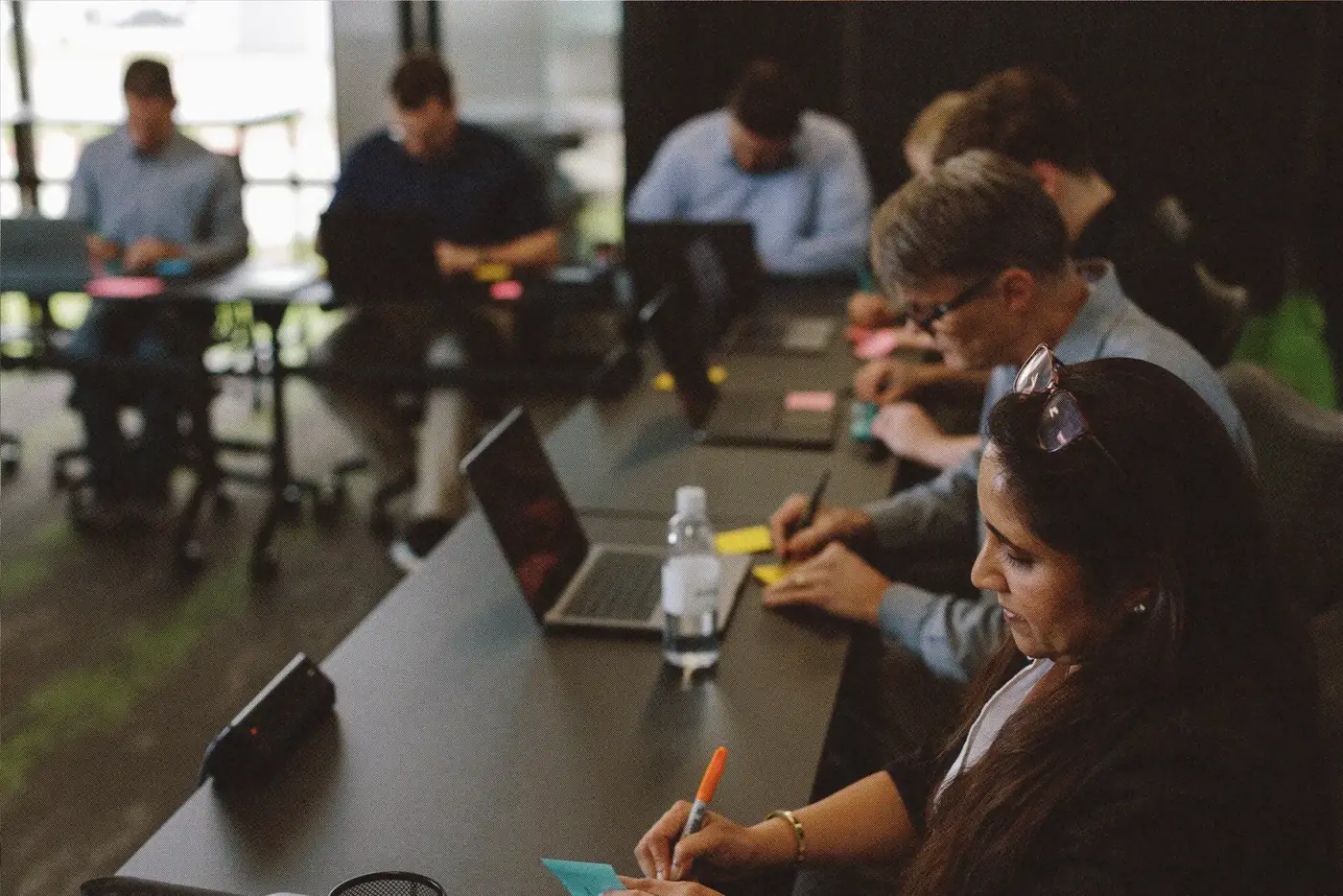
Most software projects run over or fail — and almost always for reasons that were visible early. These are the habits that keep ours on the rails.
One team, yours and ours
The people who will use the system and the people building it own it together, start to finish. Fewer hand-offs, more buy-in, faster decisions.
Visualize before you build
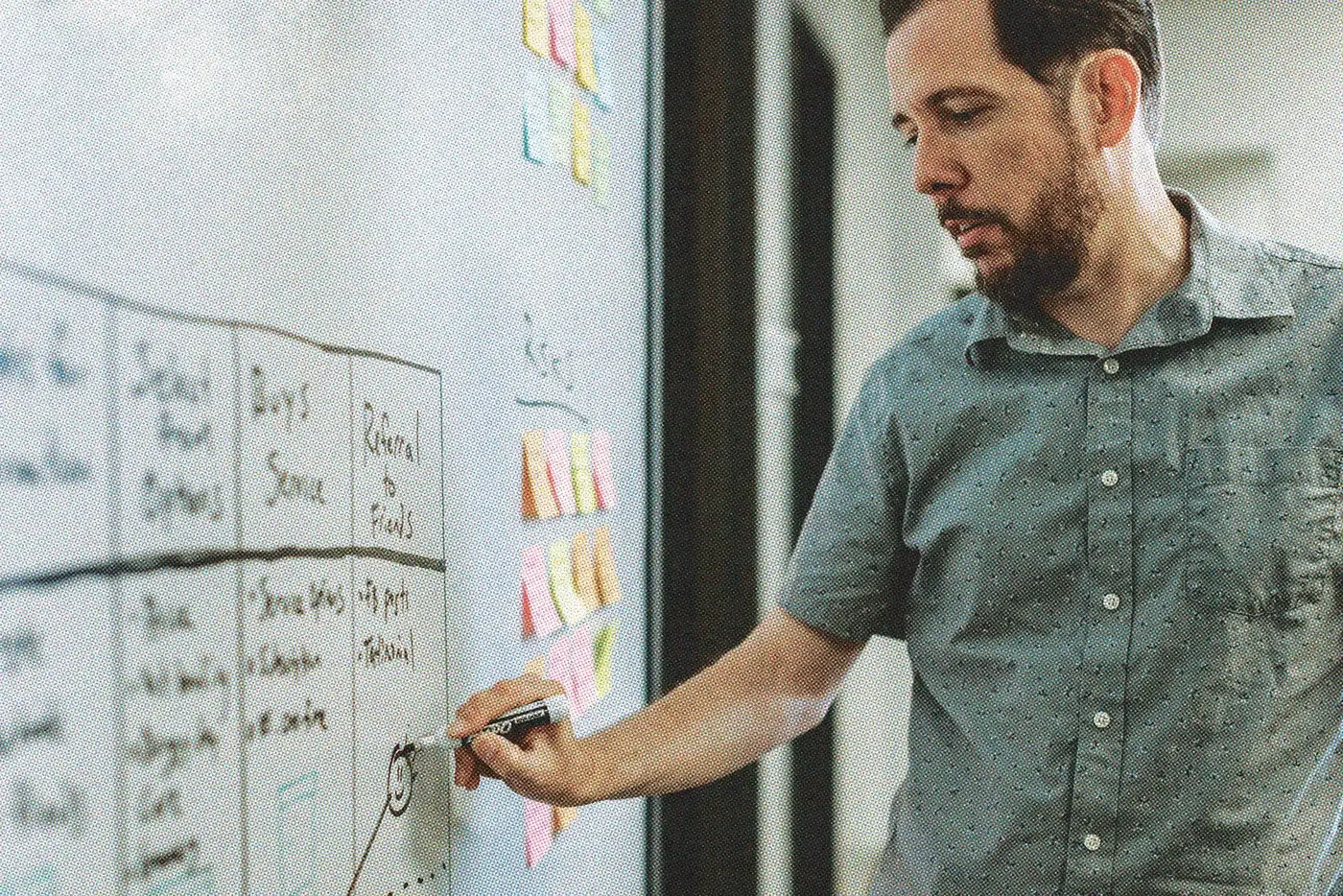
Prototypes, diagrams, storyboards. Scope, look-and-feel, and process flows get argued over on paper first, where a change costs an hour instead of a month.
Iterate on purpose
The best ideas evolve through multiple passes. Iteration removes the deadlock of trying to get it perfect the first time and forces change to happen early, when it’s cheap.
Anticipate what’s next
We look around the corner — the regulation, the acquisition, the volume spike — and build so you can adapt when it arrives instead of scrambling.
Proactive, plain-English communication
No jargon. Regular touchpoints to gather feedback, surface risk, and plan ahead. You hear about a problem from us before you notice it — and you hear what you need to hear, not what you want to.
Facts over opinions
Recommendations backed by evidence: research, user testing, real numbers. We keep an independent perspective, and our advice is never shaped by what’s good for us.
Modern tools. Professional discipline.
We build with the current generation of tools, AI included, the way a professional shop should: senior engineers directing the work and reviewing all finished work, and the disciplines that make software safe to depend on.
Technology-agnostic
The right stack for the platform and for the team who will live with it. Modern web and mobile frameworks, the major public clouds, and AI where it earns its place. No vendor ties, no reselling, and nothing chosen because it happens to be what we know.
AI-assisted, senior-directed
AI is in our workflow. Research, design, code, tests, and documentation all move faster with it. What does not change is who is accountable: senior engineers direct the work and review all finished work before it ships.
The disciplines a prototype skips
Source control, separate environments, automated tests, code review, continuous delivery, monitoring, and security designed in from the start. This is what separates software a business can run on from a demo that works until the one person who built it leaves. It is also what a System Evaluation checks for.
Speed you can see
Better tools make us faster, and you see it where it counts: working software earlier in the engagement and more of it delivered inside a fixed budget. We plan to the budget, not to the hours.
Built to last. Built to be trusted.
Tested at every stage
Automated and hands-on testing as the work is built, not a QA phase bolted on at the end. Nothing ships that we wouldn’t run our own business on.
Security & compliance built in
We’re SOC 2 Type 2. Security, access, and audit trails are designed in from day one — and when your industry has rules, the system enforces them rather than relying on process.
Cutovers you can sleep through
New work ships in slices behind the running system. If a migration needs a maintenance window, you know the date and the rollback plan in advance.
AI with a person in the loop
When we build AI into your system, the decisions that matter still go through a person, every automated action is logged, and you can see why the system did what it did.
How we work is who we are.
Our Guiding Principles are the standard for how we conduct ourselves — the way we serve clients and govern the firm. These are the ones you’ll feel on an engagement.
- Put client interests ahead of our own. If we serve you well, our own success follows. Your success is the leading indicator of ours.
- Observe high ethical standards. Integrity and honesty in everything we do. Our reputation depends on absolute adherence to this.
- Take pride in the professional quality of our work. An uncompromising determination to achieve excellence. If it came to a choice, we’d rather be great than big.
- Uphold and preserve all client confidences. We hold confidential information constantly. Misusing it would be unthinkable.
- Maintain an independent perspective. We assess every situation as an objective third party. Our recommendations are based on facts, never on our own interests.
- Manage resources cost-effectively. Upfront about fees, and we only take work where the value we provide exceeds what we charge. We spend only what’s needed to do the work to the highest standard.
- Keep a strategic perspective and build to outcomes. Start with the bigger picture, think about the whole organization, pursue impact that lasts.
- Stress teamwork in everything we do. Individual creativity is encouraged; team effort produces the best results. No room for anyone who puts themselves ahead of the client.
- Expand the art of the possible. The old way may still be the best way — but the goal isn’t to apply best practice, it’s to invent it.
- Move with a sense of competitive urgency. You’re competing. Our job is to minimize time-to-value by delivering outcomes early and often.
- Anticipate what’s next and excel at change. We look around the corner so you can adapt quickly. We can only help you cope with change by being good at it ourselves.
- Build enduring relationships based on trust. Long-term outcomes, genuine connection, and the consistent demonstration of competence and character.
Common questions about how we deliver.
How soon do we see something real?
Usually within the first few weeks, and then at the end of every cycle after that. We show working software as we go, so you see progress every week rather than a single reveal at the end.
How do you handle the budget?
We work to a fixed budget. We match the scope to the money you have, make sure there is enough for a strong first release, and never promise more than the budget can carry. You always know where the budget, schedule, and scope stand, and you hear about a risk from us before it becomes a surprise.
Who actually does the work?
Our own team, in Texas: strategists, designers, and engineers. We do not offshore or outsource, and we do not hand the work to someone you have not met. Everyone on the team, junior to senior, can talk to you directly.
How do you decide what to build first?
We start with the business problem, not the technology. We go and see how the work actually happens today, then we order the work by two things: what moves a real number soonest, and which assumption would hurt most if it turned out to be wrong.
Do you replace our systems?
Only when a system is genuinely holding you back, and we will show you the evidence. More often we build on and around what you already run. A System Evaluation is how we find out which situation you are in.
What if something is not worth building?
We tell you. If a project is not worth doing, or we are not the right fit, you will hear it on the first call. It is cheaper for everyone.
How do you measure success?
Against a business number we agree on before we start, not against whether we shipped. We measure it first, we build, and then we report what moved.
Do you use AI to build software?
Yes, as a tool inside a professional workflow. It speeds up research, design, coding, testing, and documentation. Senior engineers direct it and review all finished work before it ships, and the code lives in your repositories with tests, environments, and monitoring around it. If you already have a system that was built with AI tools and no engineering team around it, a System Evaluation is where to start.
Is our data safe?
Yes. We are SOC 2 Type 2, and security and governance are designed in from day one. Your data stays in your environment. For sensitive work we can run a private language model inside your walls so nothing leaves.
What it looks like in practice.
An expert team, Frogslayer’s strengths lie not just in development, but in their ability to consult strategically. Throughout, the team has kept the client’s best interests in mind, providing suggestions to elevate both the product and the business. Their dedication and support set them apart.
We interviewed seven firms and had a small test project. Frogslayer outperformed its competitors.
Let’s find a better way.
30 minutes, no slide deck. We’ll tell you straight where to start — and whether it’s us.